Saturday, December 28, 2013

UK trip with Lance!

Lance and Robert eating in the airport in Brussels
One Friday afternoon we happened across some very cheap tickets to Birmingham, England, and so we booked the tickets, a hotel, and a car and took off that very night for the UK with our friend Lance! Despite our lack of planning, this last-minute trip made for a very packed weekend. 

making our way down to our little prop plane


Lance on board!
 We landed at the very cheery Birmingham airport, made our way through border control and customs and picked up our rental car. 

our first views of Birmingham


Birmingham welcomes you in many languages!

 Of course...driving in the UK takes some getting used to, but Robert (being typical Robert!) was excited for the challenge. On top of adjusting to being on the other side of the road and everything complicated that comes with it, the car was a manual transmission...so Robert was shifting with his left hand! Still, we managed to make our way safely to our hotel without harming ourselves, the car, or anyone else. 

Robert driving...so confusing!


Saturday morning we set off for nearby Kenilworth Castle, and we ended up spending most of the day listening to our free audio guides amid the ruins. 

our first view of Kenilworth Castle

The castle is OLD -- the first tower was built in the 1120s! Since then, it has been expanded, built up, destroyed, and rebuilt several times. It was home to some pretty important figures in British history throughout its centuries of use. 

beautiful blue skies over Kenilworth
Lance with his audio guide


We were permitted to walk through much of the ruins, which made the experience all the more interesting. 


We were even allowed into the upper levels of much of the complex! 

Can you spot Robert?


We spotted a few employees who were part of a historical reenactment, which was especially fun for the many kids who were visiting that day. 


Of course the kitchen was my favorite part of the whole thing! It was pretty incredible to think about how much work it must have been to cook for all the inhabitants of the castle in huge cauldrons over smoky fires. 

Robert, standing in the "stove" of the main kitchen.


After finishing with our tour of Kenilworth, we headed over to enjoy some delicious fish and chips (you can't visit the UK without it, right?) in the nearby town of Coventry

Robert polishing off his plate of fish and chips

One of the more ancient settlements in Britain, Coventry is known for being the home of Lady Godiva and for surviving severe bombing during WWII, especially one particular attack known as the Coventry Blitz

statue of Lady Godiva
The bombing destroyed numerous buildings and took many lives, but possibly its most famous casualty was the Coventry Cathedral, a 14th century Gothic church which was left completely devastated by the bombing. The ruins are a popular place of pilgrimage and remembrance. 

the cathedral ruins

a group prayer service in the apse of the ruined cathedral
a view back at the ruins
 After touring the cathedral, we walked around town a bit and then headed back to our hotel. 

Lance found a seat!

Anya found some flowers
The next morning we checked out of our hotel, headed to church, and then from there to the Royal Airforce Museum in nearby Cosford. 

almost there!

our first glimpse of the many planes to come!

Robert and Lance were were like little kids Anya in a candy store. There were planes! Everywhere! Outside and inside! I think Robert could have moved in. 

reading about the history of the Royal Airforce

inside one of the many buildings full of planes!

Unfortunately our time there was short, as we had to return the rental car and get back to the airport for our flight back to Brussels. 

so long, UK!

Wednesday, November 20, 2013

Traveling Catch-Up : Our First Trip to Switzerland and a Weekend in Italy

We have quite a bit of catch-up to do with this blog since we've been busy with a combination of settling in and traveling around and haven't had much time to write about either one!

We arrived here in Leuven back in June, shortly before the feast of Pentecost, and right away we booked our tickets from Brussels to Basel, Switzerland so that we could be together with friends to celebrate the feast. Less than two weeks after arriving in Belgium we were ready to move on to our second European country of 2013.


one of the many businesses inside the Brussels Airport

Robert is no stranger to Switzerland, having spent time a couple summers doing research near Basel. There he became good friends with a Greek family at the same church where we also have a few expat friends who are parishioners. It's a small world! We were all very happy to celebrate Pentecost together. 


We didn't really take any photos on this trip, unfortunately...but fear not, there will be lots of Switzerland pics coming soon when we post about our second trip to Switzerland. Stay tuned for splendid views of the Alps! 


Monday, September 23, 2013

Silent September

Our blog has been silent for a whole month, but that doesn't mean that we've been up to nothing. Quite the contrary! We're heading to the Holy Land at the end of the week, so we wanted to make sure to squeeze in a post before we head out, so that we won't have a completely silent September.


a bike with a kid-sized bike trailer in Leuven

At the end of August, our lovely friend Anna visited en route between Ireland and Switzerland. We had a great time enjoying the beautiful weather and the pretty sites in Leuven, as well as sampling some frites and Belgian beer.


Friday morning flower market, Leuven
part of the Leuven botanical garden

Anna enjoying the Leuven botanical garden
September has been a busy month! We moved into a new apartment and we're still working on getting everything set up. Anya finalized her long-term visa and began the residency process, so we've been enjoying lots of paperwork (a Belgian national pastime, it seems). 


September skies in Leuven

The weather has definitely changed to fall, with mostly chilly, and often rainy, days and cool nights. Robert started Flemish classes and Anya will follow suit soon. Robert has been really busy with his work at imec, putting in long days working on conference proposals and all sorts of fun things. Anya is working on setting up some volunteering at a local school. We've both joined our church choir, and Anya has joined one of the university choirs. So we're settling in and staying busy! 


"Safely to School!" - proof it's September!


Friday, August 23, 2013

Basics of Belgian Cuisine

a butcher shop and deli in Leuven specializing in "game and poultry"
Our experience of food in Belgium has been one of having our stereotypes confirmed: people here really do consume vast amounts of french fries, mayonnaise, chocolate, waffles, and beer at all times of day and night. Chocolate at breakfast and beer before lunch are totally common occurrences. Mayonnaise in all its flavors works its way into almost everything, it seems, and figures prominently as the preferred dipping sauce for french fries, which are an acceptable snack at any time. Waffles are commonly eaten as a snack or a dessert-type food, and aren't typically taken at breakfast.  

Belgian eating habits are pretty similar to those of Americans: here most people eat a light breakfast, a medium lunch, and a large dinner. Dinner is not taken very late (by European standards). Judging by what I've noticed walking past restaurants, it's common to eat around 7 or maybe 8 pm, but not much later. This is in contrast especially to many Mediterranean countries, where lunch is the main meal of the day, followed by an afternoon nap, and dinner is taken quite late -- sometimes even at 10 or 11 pm! 

Later we'll post more about french fries, mayonnaise, chocolate, waffles, and beer...but for now we wanted to share a few examples of typical dishes that you may have never heard of before. These are standards on any restaurant menu and are also common foods to prepare at home. In general, the cuisine is quite similar to that of neighboring countries, with a few Belgian tweaks. For example, dishes that might be made with wine in France are, of course, made with (and served with!) beer in Belgium. And french fries are the standard carbohydrate of choice to accompany any main dish. 

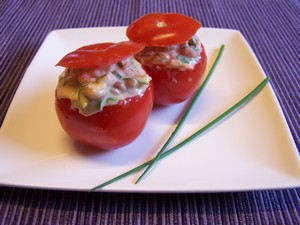
photo courtesy of: http://www.plat-du-jour.net/recettes/entrees/tomate-aux-crevettes/
tomate-crevette / tomaat-garnaal : a hollowed out plain raw tomato stuffed with small cooked grey shrimp (crevettes grises / grijze garnaal) from the North Sea mixed with mayonnaise. We've seen this as a starter on many restaurant menus.


photo courtesy of Wikipedia
moules frites / mosselen-friet : mussels steamed together with onions and celery (or sometimes with a fancier sauce), served with french fries (of course!); many consider this Belgium's national dish. It is available pretty much everywhere, especially at this time of year when mussels are in season. The grocery store even has a display case where they are selling packages of fresh cleaned mussels, prepared packets of cut celery and onions, and bags of peeled potatoes cut and ready to be fried. I've seen a number of people run into the store, grab a bag of each, and head home equipped to prepare a quick dinner. 


photo courtesy of Food Network
waterzooi : a rich soup or stew made of chicken or, more traditionally, fish with a base of cream and egg yolks. This dish originated in Ghent and is decidedly Flemish. 


http://www.break-point.info/wp/?menu-food=filet-americain-prepare
filet américain : contrary to what it sounds like, this is NOT an American-style steak! It's the Belgian version of steak tartare: finely minced raw beef, eaten cold and often spread on bread. Here it's usually served with sauce américaine  (yet another flavored mayonnaise) and...wait for it...french fries! Sometimes it is mixed with raw onions and capers, like a more traditional steak tartare. We've seen this on many restaurant menus and it's available from the deli counter at the local grocery store.


http://www.visitflanders.co.uk/discover/flanders/flemish-specialities/stoemp/
stoemp : another very Flemish dish, stoemp is a simple side of mashed potato with other vegetables such as Belgian endive (chicory), Brussels sprouts, cabbage, carrots, kale, spinach, or other greens. It's similar to the Irish colcannon. It's typically served with sausages, which are one of the most beloved protein sources in Belgium, or maybe with bacon. Or, as pictured here, with both! 


http://www.een.be/programmas/dagelijkse-kost/recepten/stoofvlees-met-friet
carbonnades flamandes / stoverij : here is an example of a classic French dish prepared in a Belgian way. This beef stew is basically beef bourguignon, but made with beer instead of red wine, and served with french fries and more beer to wash it all down. Mustard is a common accompaniment, but in the photo above, it seems they chose mayonnaise instead. Are you surprised? 

Thursday, August 22, 2013

Quick Facts About Belgium

This is the post for those of you who have lots of questions about Belgium. While we don't want to bore you with too many details, we figured we ought to share a quick overview here. 


image courtesy of Wikipedia

Geography
Belgium is a small country located in Western Europe. With an area of 30,528 square kilometers (11,787 sq mi), it's about the size of the state of Maryland. It is very densely populated: over 11 million people live in Belgium, whereas only a little over half that many live in Maryland!

Belgium shares a border with the Netherlands to the north, Germany to the east, Luxembourg to the southeast, France to the south/southwest, and it has a small stretch of coastline bordering the North Sea on its western edge. 


typical Flemish countryside near Leuven, complete with a characteristic grey sky

The country is divided into roughly three areas in terms of its topography or physical geography: you have the coastal area near the North Sea, full of sand dunes and flat flood plains (often protected by dikes, just like in the Netherlands), the central plain, with its gently (very gently!) rolling hills, perfect for farming (this includes the area around Leuven), and the Ardennes, the densely wooded and at times rocky and craggy area in the southwest of the country. The Ardennes are very popular for camping and outdoor sports, and aren't much good for farming due to the rugged landscape. As you can see from the map above, Belgium doesn't have much in terms of rivers or lakes, and its highest point, Signal de Botrange in the Ardennes, is only 694 meters above sea level. All in all, the terrain here isn't the most exciting or beautiful: Belgium is not the place to visit if you're interested in Europe's natural beauty. 


a typical cloudy sky over the Arenberg Castle in Heverlee
Climate
Like most of its neighbors, Belgium has a maritime temperate climate, basically meaning that it's cool, wet, and cloudy for most of the year. Winters are mild and summers don't get all that hot, although this year we had an unexpectedly hot stretch in the mid to low 30s C (that's upper 80s and lower 90s F), even getting up to 36 C for a day or two (about 97 F!). It was quite unpleasant since nothing here is equipped for heat: very few buildings have air conditioning, window screens are an almost unheard of luxury, and even fans are hard to come by. It also tends to be quite humid here, so even temperatures in the lower 80s can become miserable pretty quickly.


the Atomium, as seen while taking off in Brussels
Capital and Government
The capital and largest city is Brussels, which is an important center for international politics. It serves as the capital of the European Union, and hosts four out of its seven principal governing institutions. The NATO headquarters can also be found in Brussels, in addition to the World Customs Organization, and over one thousand international charities and non-governmental organizations. You might also know it as home of the Manneken Pis and the Atomium.

Belgium's government is a federal parliamentary constitutional monarchy. (Don't ask me to explain what that means, though.) The current prime minister is Elio Di Rupo (yes, he's 100% ethnically Italian) and the newly-instated (as of July 2013!) monarch is King Philippe.


Language and Culture
Now for the interesting part! Belgium, tiny though it may be, is home to three distinct cultural/linguistic groups. This has resulted in the division of the country into different regions and language communities, as you can see in the map below:


languages spoken:

  Dutch

  French

  German
  Dutch/French


image courtesy of Wikipedia


"knock please (bell doesn't work)"
in Dutch/Flemish on an apartment window in Leuven


The yellow part in the north is known as the Flemish Region, or Flanders, and it is home to the Dutch-speaking Flemish community. Flemish people are the majority, making up about 60% of the population. 

Leuven is in Flanders, so where we live, everyone speaks the Belgian dialect of Dutch, known as Flemish. English is the second language here: signs are more likely to be in Flemish and English than in Flemish and French.


a McDonald's advertisement in French
(complete with French flag!) in the Brussels Metro


The red part in the south is known as the Walloon Region, or Wallonia, and it is home to the French-speaking Walloons, who make up about 40% of Belgium's population. Wallonia is also the home of the small population of German speakers, in the east along the border with Germany. 

The orange part contained within Flanders is the Brussels-Capital Region, where Brussels is. Although it's contained within Flanders, the capital is officially bilingual...but the majority of people there speak French. 


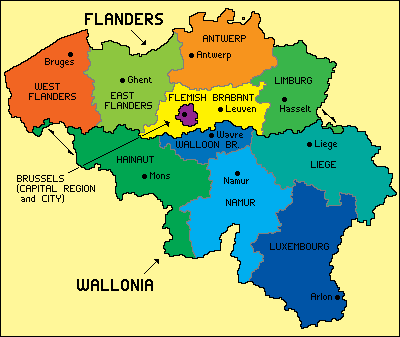
Flanders and Wallonia are each divided into 5 provinces, and as you can see from the map below, Leuven (our city) is the capital of the Flemish Brabant province in Flanders. This is the province that encompasses the Brussels-Capital Region. The border separating Flanders and Wallonia is less than 10 kilometers from where we live right now -- three stops south of us on the train, and we're in a French-speaking town!


image courtesy of Wikipedia
Unfortunately there's quite a bit of antagonism between Flanders and Wallonia, especially the former is better off economically than the latter, so many Flemish people feel that they are subsidizing public services for Walloons. This puts a strain on the Belgian government and has caused a number of governmental crises, including the over 500 days Belgium went with no government in 2010-2011. The government is now fairly divided, with Flanders and Wallonia having their own governing systems, each in its official language. 

So, that's it for the basics. If you have any specific questions, please don't hesitate to leave them in the comments and we'll do our best to answer them.